How I hunt down (and fix) errors in production
Once you’ve deployed your web app to prod there is a moment of satisfaction: a brief respite where you can reflect on your hard work. You sit, adoringly refreshing the homepage of www.mysite.com to watch it load over and over. It’s beautiful, perfect, timeless. A glittering …
How to setup Django with Pytest on GitHub Actions
Someone recently asked me
When is a good time to get automated testing setup on a new Django project?
The answer is "now". There are other good times, but now is best. In this post I'll briefly make my case for why, and show you an example of a minimal …
My (free) Django monitoring stack for 2022
You've built and deployed a website using Django. Congrats!
After that initial high of successfully launching your site comes the grubby work of fixing bugs. There are so many things that can will go wrong.
Pages may crash with 500 errors in prod, but not locally. Some offline tasks never …
DevOps in academic research
I'd like to share some things I've learned and done in the 18 months I worked as a "Research DevOps Specialist" for a team of infectious disease epidemiologists. Prior to this job I'd worked as a web developer for four years and I'd found that the day-to-day had become quite …
How to setup Django with React
It's not too hard to get started with either Django or React. Both have great documentation and there are lots of tutorials online. The tricky part is getting them to work together. Many people start with a Django project and then decide that they want to "add React" to it …
A Django project blueprint to help you learn by doing
There's an awkward point when you're learning Django where you've done the official tutorial and maybe built a simple project, like a to-do list, and now you want to try something a little more advanced. People say that you should "learn by building things", which is good advice, but it …
Django project blueprint: data model
This post is an appendix to my post on designing a Django project. In this page I explain why I chose to use this data model:
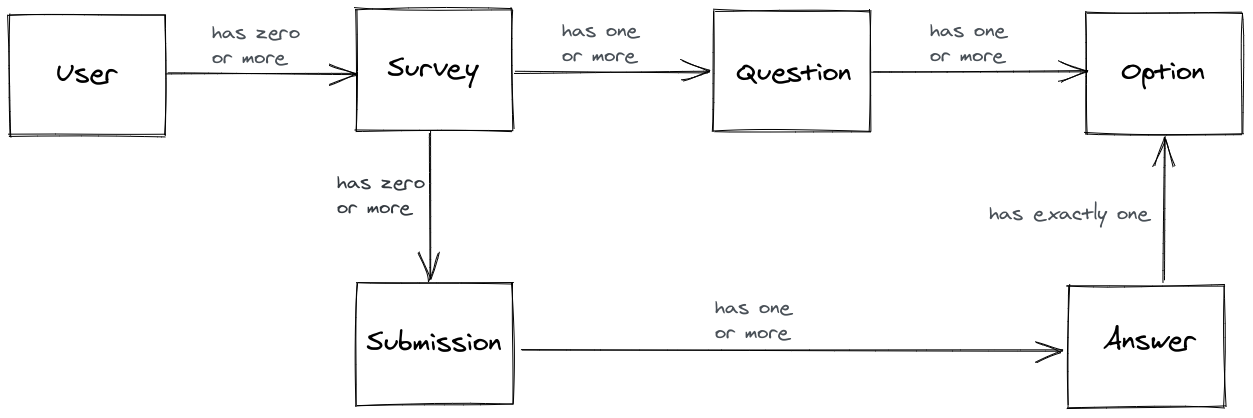
I created this data model by looking at the user journeys and thinking about what data I would need to make them work. Here's …
Django project blueprint: wireframes
This post is an appendix to my post on designing a Django project. This page shows all the wireframes for the app, with some additional notes for each page.
Page designs for the user who answers the survey
This section covers the pages required for the "survey taker" user journey …
A breakdown of how NGINX is configured with Django
You are trying to deploy your Django web app to the internet. You have never done this before, so you follow a guide like this one. The guide gives you many instructions, which includes installing and configuring an "NGINX reverse proxy". At some point you mutter to yourself:
What-the-hell is …
How to manage logs with Django, Gunicorn and NGINX
So you want to run a Django app using NGINX and Gunicorn. Did you notice that all three of these tools have logging options? You can configure Django logging, Gunicorn logging, and NGINX logging.
You just want to see what's happening in your Django app so that you can fix …
How to make your Django project easy to move and share
You need your Django project to be portable. It should be quick and easy to start it up on a new laptop. If it isn't portable, then your project is trapped on your machine. If it gets deleted or corrupted, then you've lost all your work! This issue comes up …
Is Django too slow?
Does Django have "bad performance"? The framework is now 15 years old. Is it out of date? Mostly, no. I think that Django's performance is perfectly fine for most use-cases. In this post I'll review different aspects of Django's "performance" as a web framework and discuss how you can decide …
There's no one right way to test your code
Today I read a Reddit thread where a beginner was stumbling over themself, apologizing for writing tests the "wrong way":
I'm now writing some unit tests ... I know that the correct way would be to write tests first and then the code, but unfortunately it had to be done this …
How to find what you want in the Django documentation
Many beginner programmers find the Django documentation overwhelming.
Let's say you want to learn how to perform a login for a user. Seems like it would be pretty simple: logins are a core feature of Django. If you google for "django login" or search the docs you see a few …
How to pull production data into your local Postgres database
Sometimes you want to write a feature for your Django app that requires a lot of structured data that already exists in production. This happened to me recently: I needed to create a reporting tool for internal business users. The problem was that I didn't have much data in my …
How to polish your GitHub projects when you're looking for a job
When you're going for your first programming job, you don't have any work experience or references to show that you can write code. You might not even have a relevant degree (I didn't). What you can do is write some code and throw it up on GitHub to demonstrate to …
How to generate lots of dummy data for your Django app
It sucks when you're working on a Django app and all your pages are empty. For example, if you're working on a forum webapp, then all your discussion boards will be empty by default:

Manually creating enough data for your pages to look realistic is a lot of work. Wouldn't …
How to automatically reset your local Django database
Sometimes when you're working on a Django app you want a fresh start. You want to nuke all of the data in your local database and start again from scratch. Maybe you ran some migrations that you don't want to keep, or perhaps there's some test data that you want …
How to automate your Postgres database backups
If you've got a web app running in production, then you'll want to take regular database backups, or else you risk losing all your data. Taking these backups manually is fine, but it's easy to forget to do it. It's better to remove the chance of human error and automate …
An introduction to cloud file storage
Sometimes when you're running a web app you will find that you have a lot of files on your server. All these files will start to feel like a burden. You might worry about losing them all if the server fails, or you might be concerned about running out of …